
RS-422/RS-485 Communication Topologies and Versa-Tap Sniffer
RS-422 and RS-485 are differential serial protocols designed to handle longer cable runs and noisier environments than RS-232. Both standards support multiple wiring topologies depending on whether you need one-way or two-way communication, point-to-point or multi-drop networks, and 2-wire or 4-wire signaling.
This guide covers the four main RS-422/RS-485 topology configurations, when each is used, and how to connect a Versa-Tap for passive monitoring.
Full Duplex 4-wire RS-422/RS-485 Point to Point Connection
The simplest and most common RS-422/RS-485 interface is the 4-wire full-duplex point-to-point connection shown below. Communication is functionally similar to RS-232 but with the improved noise immunity and longer reach of differential signaling. This is the right choice when you have exactly two devices that need to talk to each other in both directions simultaneously, and you want the simplest possible protocol implementation.
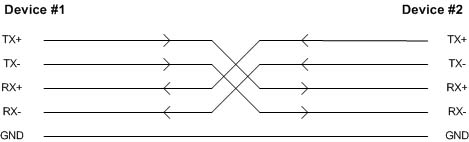 Full-Duplex Point to Point Connection
Half Duplex 2-wire RS-422/RS-485 Point to Point Connection
The 2-wire half-duplex point-to-point connection saves cabling cost at the expense of increased protocol complexity. The two devices share a single wire pair, so they need a protocol to take turns transmitting. This is typically done in a master/slave arrangement: the master sends a command, then tri-states its RS-422/RS-485 driver while the slave responds. The slave drives the bus, responds, then tri-states in preparation for the next command. Use this topology when cabling cost matters more than protocol simplicity, or when working with legacy 2-wire systems.
 Half-Duplex Point to Point Connection
4-wire RS-422/RS-485 Multi-drop Connection
The 4-wire multi-drop connection supports networking where a master device communicates with multiple slaves. The master broadcasts to all slaves simultaneously, using a slave address in each command to specify which device should respond. Each slave listens to every command and responds only when it detects a match with its pre-designated address. This is the topology used in many industrial automation and building control networks.
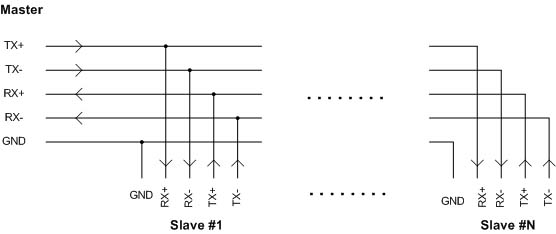 4-Wire Multi-drop Connection
2-wire RS-422/RS-485 Multi-drop Connection
Like the 4-wire multi-drop, the 2-wire version supports networking between one master and multiple slaves — with the additional cost savings of using only one wire pair. The master broadcasts messages with slave addresses, listens for the addressed slave’s response, then issues the next command. Modbus RTU and many other industrial protocols use this topology.
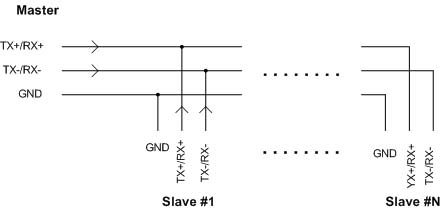 2-Wire Multi-drop Connection
Versa-Tap Connections for 4-wire RS-422/RS-485 Interface
The Versa-Tap connections are the same for both 4-wire point-to-point and 4-wire multi-drop configurations. Connect the Versa-Tap TX+ and TX- terminals to the RS-422/RS-485 master TX+ and TX- signals, and the Versa-Tap RX+ and RX- terminals to the RS-422/RS-485 master RX+ and RX- signals. Note that RS-422/RS-485 “+” and “-” signals are sometimes labeled “A” and “B” respectively.
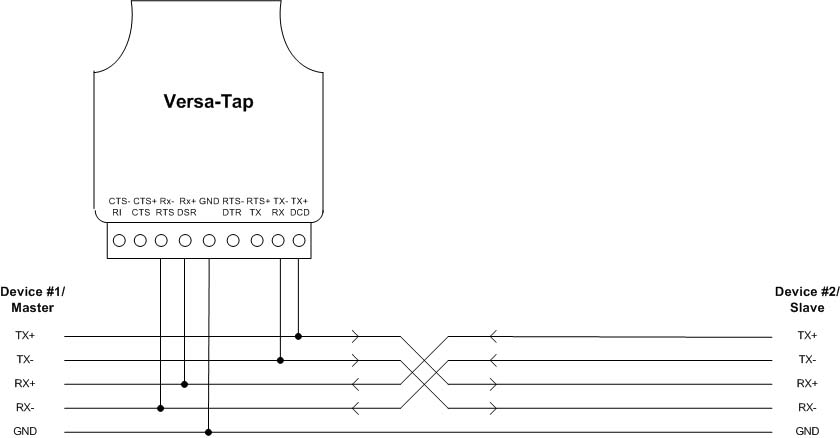 Versa-Tap 4-Wire Connections
Versa-Tap Connections for 2-wire RS-422/RS-485 Interface
For 2-wire point-to-point and 2-wire multi-drop configurations, connect the Versa-Tap TX+ and TX- terminals to the RS-422/RS-485 master TX+ and TX- signals. Again, RS-422/RS-485 “+” and “-” signals are sometimes labeled “A” and “B” respectively.
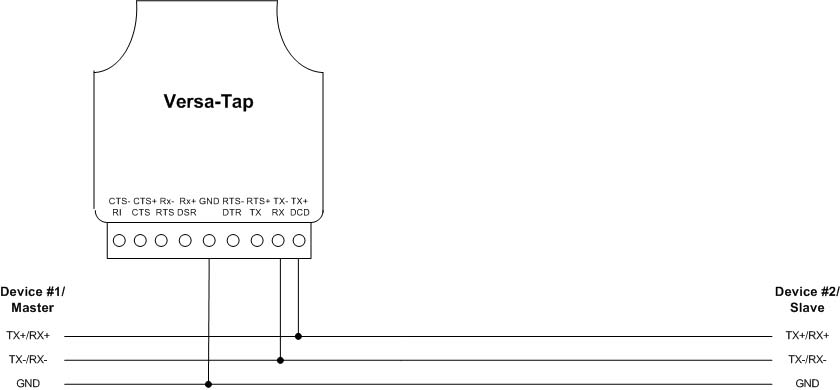 Versa-Tap 2-Wire Connections